Showing posts with label science. Show all posts

Wednesday, August 31, 2011

Kraken

Here it is, the completed octopus quilt!


The quilting, which I'm quite happy with, shows up really well on the back.


The backing matches the narrow outer border on the front.


Here are a couple more closeups. Hooray for another quilt completed!


Did you know that the largest octopus on record weighed over 150 pounds? Octopi are very intelligent too, so this would probably be a good quilt to study under.

Thursday, June 30, 2011

The Pseudo-Random Quilt Block Distribution Problem

After cutting up my 10 colors of Quilter's Tweed (very carefully, with no room for error, in order to get the most out of the fabric), I found myself with a problem that I've encountered more than once in my not-so-terribly-long quilting career. Since it's such an interesting fabric, I'm going with a very simple quilt design--rectangular blocks sewn in columns, half-offset. I don't want to go with a constantly repeating order of colors; rather I want them randomly scattered across the quilt.

Except, of course, I don't really want a random pattern.

I first encountered this problem a couple of years ago with my best-friend-from-high-school's wedding quilt:

I can't believe I didn't take better pictures of it.

It's a double wedding ring that I put together from a quilt kit I bought, because I wasn't confident enough to try cutting all those teeny curved pieces myself. If you look closely in this picture, you can see that the fabrics in the kit were, in more than one instance, the same fabric but in a different color.


I wanted the 24 fabrics in the pieced arcs to be random--except, of course, I didn't ever want the same fabric next to itself, and while the same pattern but different colors next to each other was OK, I didn't want that to happen too often. And I didn't want the one color of fabric to another fabric of a very similar color too often. So it really wasn't random at all, with all those rules, and it became rather difficult.

After I finished the top, I mentioned the problem to a crocheter friend who was, at the time, working on a baby blanket made up of log cabin-patterned granny squares that used four different colors. She realized she was going to face the same problem when she was ready to put them together, and we started talking about the fact that there really ought to be a computer program that could tell you what block you should put where.

Unfortunately, once you start thinking about how to codify the rules, you realize that this is actually a much more difficult problem than it at first appears. Things like "these fabrics should sometimes but not often be next to each other" and patterns like a double wedding ring which doesn't fit nicely into a computer grid are actually really hard to deal with. Nevertheless, since my friend is a much better computer programmer than I am, she managed to write a simple program that can handle a rectangular grid and minimum separation distances. (At the moment, it's not stand-alone software, so unfortunately if I were to share it with you at this point you'd still need the programming language software. Someday, though...)

At the moment, you set up a grid of allowable distances between each different block (in this case, color of Quilter's Tweed) and tell the program how many of each block you have.


You give it the size of the quilt grid into which to put the blocks, and the program goes through the grid methodically, selecting a random block and then checking to see whether or not it meets the distance requirements. If not, it selects a different one; if it can't find one that will fit, it starts backtracking.

As you might imagine, this ends up being rather, as they say in the programming world, "computationally intensive." For my Quilter's Tweed quilt, I said that at least one other block had to separate the same color. With 10 colors, the program managed to spit out a grid in a minute or so. Then, I thought I'd change it to two blocks separating identical colors--and after 3 hours, it was still running (at which point I either accidentally quit, or the software crashed). It also took about 3 hours to find a layout for my friend's baby blanket--so we would like to find a way to do this whole thing more efficiently, in addition to adding a bunch of other features that might make it more versatile.

In the meantime, though, I'm going with one of the grids that the program did spit out.

Every other column will be half-offset.

I'm eager to see if the final quilt will show the desired effect!

Thursday, May 26, 2011

Hydrothermal Vent Worm Plushie

I'm afraid I don't have a particularly good picture of this project, but I made this plush hydrothermal vent worm for a fellow marine scientist as a graduation gift several years ago.


I already talked about hydrothermal vent worms here. Or you could just read Wikipedia.

The pattern is my own. I wish I could find it again, because I keep thinking I should make them to sell on Etsy or something like that. Fortunately, these guys have a pretty simple shape!

Sunday, April 24, 2011

Sunday Stash Report

I haven't used an inch of fabric this week, I'm afraid, although I did manage to finish one of the fingerless gloves I've been knitting:


I have an excuse, though--I've been here all week:

Yes, it really was that color. I never understood the "ultramarine blue" in my watercolor sets until this week.

Yup, I've been on a cruise! The kind of cruise where you are awake and filtering water at 3 a.m., that is. It was awesome, though. Here was our boat:


There are a few more pictures after the jump for anyone who is interested in what an oceanographic research cruise is like!

Used This Week: 0
Used Year To Date: 18.625
Added This Week: 0
Added Year To Date: 51.25
Net Used For 2011: -32.625


See how everyone else is doing.


Friday, March 25, 2011

Marine Snow

One of the quilts which I entered into the recent quilt show and which I haven't posted about here yet is called "Marine Snow." I also just entered it in a Weekly Themed Quilt Contest here (you can go vote if you'd like to!). I made it as a birthday gift for my fiance, who does research on marine snow. Marine snow is--in his words, the technical terms of a prominent researcher on the subject--"dead crud that sinks."

Here it is hanging in the quilt show.


More specifically, marine snow consists of dead algae, small plants, poop, and other detritus that clumps together and slowly sinks. (I just realized I made a quilt about poop. That's got to be a new low in quiltmaking...) It's called marine snow because it looks a lot like snow (sorry that video is a bit jargon-y, but it has a nice shot of the stuff at the beginning). The reason marine snow is interesting to scientists is that there is a lot of carbon in it, and when carbon sinks to the deep ocean it stays there for a long time. Carbon, as I'm sure you know, is important as a greenhouse gas in the atmosphere. It moves between the atmosphere and the ocean, and so if a lot of carbon sinks to the deep ocean that means it's not in the atmosphere contributing to the greenhouse effect.


I quilted it with long meandering vertical lines, which are supposed to represent the paths the particles take as they sink, although if you look at them horizontally they could also be waves in the ocean!

This quilt is the "Confetti" pattern from the book StrataVarious Quilts by Barbara Persing and Mary Hoover. His favorite color is teal, so I kept that from the original pattern and just switched out the colors of the "confetti" pieces. I'm really pleased with the way it turned out, although it was a pretty labor-intensive pattern and wasted a lot of fabric (something I am not a big fan of!). And he seems to be pretty happy with it, too!

Monday, February 7, 2011

Global Warming Quilt

With days to spare, I've finally finished my Show Challenge quilt for the upcoming Cotton Patch Quilt Show! The theme is Hot Threads, Cool Quilts, and the Show Challenge was to interpret this theme and that the quilt have dimensional elements. We presented the tops back in December, but now it's almost time to turn in the show quilts!

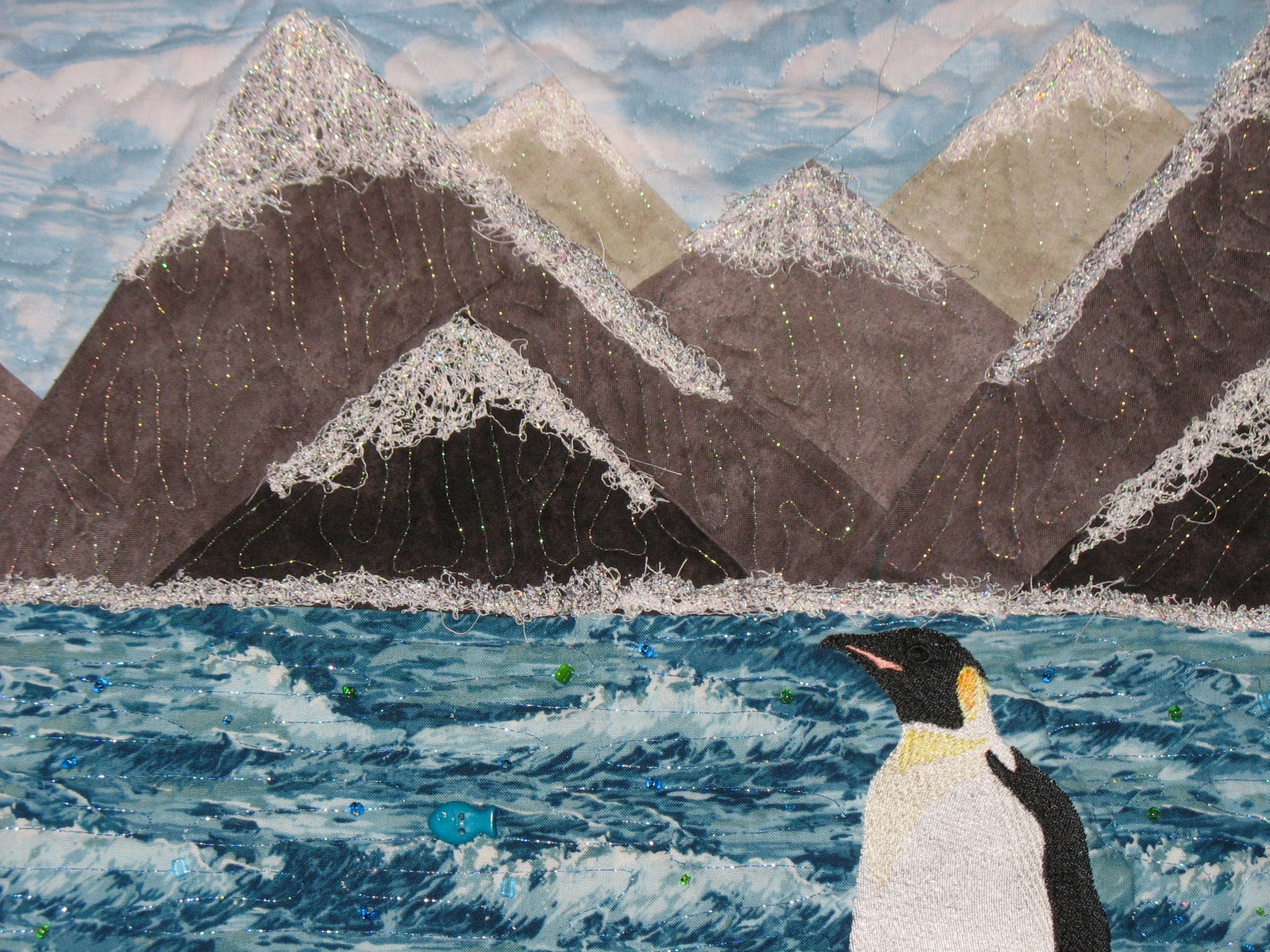
My interpretation of the theme was "Global Warming." Here is the finished quilt:


I had a lot of difficulty with it due to the ruffling in the borders. I really like the effect but it made the quilt somewhat uneven on the edges, and it ended up lopsided which I fixed according to the measuring tape but not the picture. It's not my best effort ever, but there are parts of it I'm really happy with.


See? Pretty good in closeup. I used sparkly thread to quilt, so it's all very glittery and icy.

I wanted to make a polar scene because the effects of global warming are greatest at the poles. (I thought of doing the Arctic and having a polar bear, which is the iconic victim of global warming, but the penguin embroidery design just worked better in this quilt. Sorry, polar bears.) This is because the poles are covered in ice and snow. As you know if you've ever walked outside on a sunny day when there's snow on the ground, it's bright--the snow is reflecting the sun's rays back into space. As the ice melts, less of the sun's rays are reflected back into space and the water/land absorbs the warmth from the sun, making more ice melt, and so on. For more about the science behind global warming, here's a good website.

Unfortunately, I was not the only quilter whose interpretation of Hot/Cold was global warming--or whose quilt involved penguins. Out of 16 quilts presented for the challenge, three had penguins on them. Oops, guess I wasn't very original this time around.

Saturday, January 29, 2011

The Other 71%

This past week, I had the fabulous opportunity to have lunch with my namesake, the amazing and inspiring Sylvia Earle. Since I've been spending most of my crafty time getting my quilts ready for the upcoming quilt show (sewing on hanging sleeves and labels--what fun!), I thought I'd share with you the second quilt I made, which was inspired by all the neat stuff in the ocean, and which will be going in the show.

I thought the "watercolor" table runner in the first quilt book I bought was a cool idea, but have never been a big fan of florals. However, I was finding lots of fun aquatic-themed quilt fabric and decided that I'd use this technique to make a marine science themed quilt, since that's my field.


I tried to put in as many nerdy details as I could.

A bacterium quilt square
A jellyfish and a machine-appliquéd deep-sea anglerfish 

My very favorite part of the quilt are the hydrothermal vent worms.


Hydrothermal vents are totally awesome. Basically, they're jets of hot water (and by hot, I mean 600+ degrees F--it doesn't boil because the pressure is so great) in the freezing depths of the ocean. Most of the ocean floor is actually pretty much a wasteland--but in these places, there is an amazing variety of life, the most striking of which are hydrothermal vent worms. What's so cool about them is that sunlight doesn't penetrate the ocean to those depths (the vents can be up to three miles under the surface of the ocean), and until they were discovered in the 1970s no one had any idea it was even possible for life to exist without sunlight.

Some more pictures:
The white at the top left represents the ice caps.

There's that bacterium at the upper right. Many of the other fabrics in the quilt remind me of things like tiny algae, seaweed, and different kinds of bacteria.
This is the deep-ocean part of the quilt. There's a giant squid at the top left. Lots of animals in the deep ocean are red, hence all the red here.
Here you can see the seafloor. There's kelp and corals at the top left (OK, a bit of a juxtaposition there, but I had to fit everything in somehow!), and lots of sea life around them!

I quilted the majority of the quilt with a wave pattern, but around the edges I used blue and red sparkly thread to portray the thermohaline circulation.

The thermohaline circulation is the large-scale circulation of the oceans. "Thermo" of course means heat, and "haline" means salty because the temperature and the salt content of the water are what drive it (yes, the ocean is saltier in some places than in others!). Basically, cold salty water (sparkly blue thread) is denser than warm not-as-salty (sparkly red thread) water, so you end up with water from the surface of the ocean sinking down to the depths near the poles. That allows warm water from near the equator to flow in to fill its place--you know it as the Gulf Stream, and it keeps places like England habitable.

The title of the quilt comes from the fact only 29% of the Earth's surface is land, but we often forget about the other 71%, which is a pretty cool place.